You're buying in a used Tesla, and the previous owner hands you their phone. The screenshot shows high battery health and an impressive full-charge range. The numbers look good, so the price is agreed around them. A few months later the car belongs to a buyer, and the numbers on the screen don't look quite the same.
The numbers on the screen aren't fake. They're a good place to start. But the car estimates them; nobody measures them. Estimates drift, and the screen can also be tidied up to look better than the battery really is. Along the way, the dealer and the buyer may both be looking at the same flattering number.
The screen shows the car's own estimates
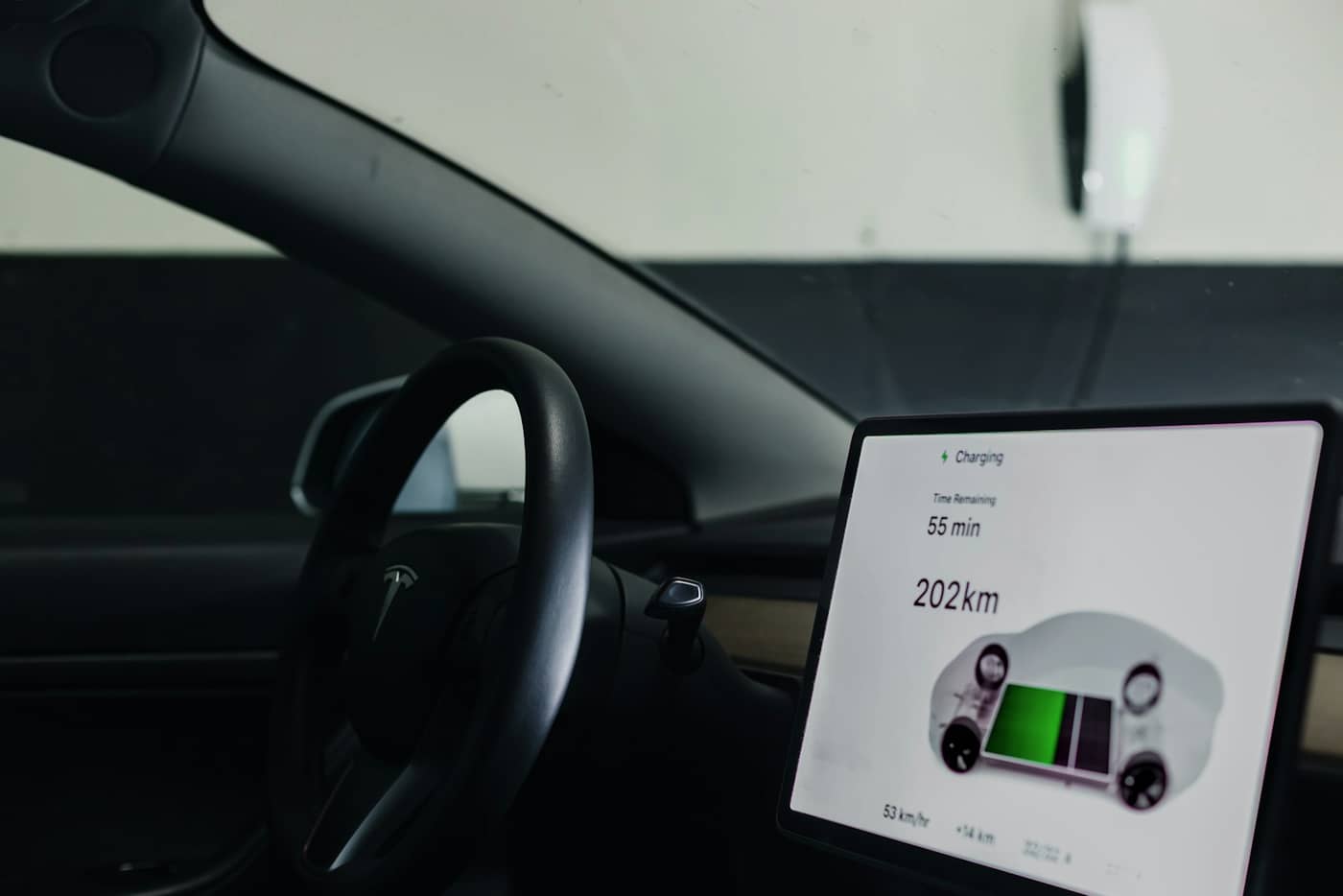
Range, in Tesla's own words, is an estimated distance per charge. Shown in kilometres, it's based on standard test (EPA) data, not on how you drive, and you can switch it to show the battery percentage instead[1].
Battery health is an estimate too. According to the owner's manual, the battery health figure on the screen is calculated from the battery management system's data, then compared with the capacity expected for that battery type, age and usage[2]. Tesla's warranty puts it more bluntly: the estimated range doesn't fully reflect the battery's capacity, because many other factors affect it[3].
In other words, these numbers are the car's estimate of itself, not a measurement.
Every battery number on the screen is an estimate
From Tesla Taiwan's website and the Model 3 Owner's Manual
Range in km
The estimated distance per charge. In kilometres it's based on standard test data, not your driving; it can show a percentage instead.
Battery health
Calculated from the battery management system's data, then compared with the capacity expected for that battery type, age and usage.
Battery Health Test
Needs AC charging for up to 24 hours. Some cars don't have it; afterwards, the estimated range on the screen may be recalibrated.
The same battery, different numbers
Recurrent, a US company that researches EV batteries, explains that the battery management system works out how much charge is left by building on its previous estimate, so an error along the way can compound[4]. After a period of use, or a major software update that affects range, it may take a full charge for the estimate to recalibrate[4].
Tesla's software updates change the estimate too. The notes for an update in March 2025 said the battery's energy estimate now takes the car's usage into account and adjusts over time based on its history, while the total battery energy stays the same[5]. Running the Battery Health Test may also recalibrate the estimated range[2][6]. So the same battery can show numbers that are better than reality, or worse.
Researchers have looked at how well self-reported health holds up. A Korean study that followed 1,114 EVs found real capacity varied by 12% to 25% within the same model while the cars' self-reported health didn't reflect those differences; but the cars were Hyundai, Kia, Genesis, Audi and Volkswagen, with no Teslas, and the study is a preprint that hasn't yet been peer-reviewed[7].
The screen can be tidied up to look better
The estimate moves on its own, and what you're shown can also be chosen. Any of these can happen:
- The best-looking moment: right after a full charge, when the estimate has just recalibrated, is when the numbers on the screen may look their very best[2][4].
- Kilometres at a high charge: a photo taken at a very high charge shows the most kilometres of range[1]; put photos of different cars at different charge levels side by side, and they're easy to misread.
- Warnings swiped away: pop-up alerts can be swiped down to close them, but the full list stays under the bell at the top of Controls[8].
- Another car's screenshot, or an old one: a photo carries no VIN, and nothing in it shows the day it was taken.
- What the screen never says: a warranty replacement battery may be new, refurbished or remanufactured[3]; whether a battery was replaced, or what was repaired, doesn't show in the numbers on the screen.
It can go like this: the seller tidies up the screen, the dealer values and lists the car in good faith, and the buyer finds out after a while on the road. The dealer, too, is swayed by the numbers, on the same side as the buyer. All of this can happen, but there is no Taiwan data on how often it does.
The numbers themselves can technically be altered too. In 2023, researchers from TU Berlin showed they could take full control of a Tesla's centre-screen computer, but only with physical access to the car and specialist equipment, and what they turned on was paid features, not battery numbers[9]. We found no public case of anyone altering battery numbers to sell a car, in Taiwan or elsewhere. But if the numbers can be altered, no check that only reads the car's data, whether the screen, a screenshot, the car's own test or a quick read, can rule it out completely; measuring the battery is much harder to fake than reading an estimate, but no test can claim it can never be fooled.
Checking before you buy in or buy
Dealers: Recurrent estimates the battery can be up to 30 to 50% of an EV's value[10]. So test the battery at intake: you know what you're paying for before you pay, not after you've listed the car. A car bought in at a top price deserves a measured test, not just a look at the screen.
Buyers looking at a car can ask for these:
- A result tied to the VIN: dated, and checkable online by anyone, not just a screenshot.
- Who measured it: is it the car's own estimate, or an actual measurement?
- The screen, in person: with the car switched on, look at the range and battery health there and then, and open the alert list under the bell[8].
- Whether the battery was replaced: ask the seller for Tesla's service records. How the warranty works is in "Out of warranty by 3 days, NT$650,000 out of pocket".
A quick read of the car's data reads the same estimate. CELLPROOF's SWIFT is that kind of check: its results will be labelled "Car-reported battery health" and tied to the VIN read from the car and to the test date, and once a certificate is issued it can be verified online. It reads cell balance too (why that matters: "Battery health at 90%: does that mean the battery is fine?"). For an actual capacity figure, DEEP measures it over one full charge.
The numbers on the screen aren't fake; they just move, they can be picked, and screenshots get passed around. When it's time to pay, ask one more question: which car, which day, and who measured it?
First ask whether the number was estimated or measured, then look at how good it is.
Sources
- Tesla Taiwan, "續航里程提示" (Range tips).
- Tesla, "高電壓電池健康" (High voltage battery health), Model 3 Owner's Manual, Traditional Chinese edition.
- Tesla, "新車品質有限保固條款" (New Vehicle Limited Warranty, Asia Pacific), effective 8 July 2024: the Battery and Drive Unit Limited Warranty.
- Recurrent, Brandon August, "Do I Need to Charge My Car to 100%?", 7 March 2023.
- Tesla, software update 2025.8.3 release notes, as reproduced by Not a Tesla App: "Update 2025.8.3 - Release Notes", 15 March 2025.
- Tessie, "Calibrating the Battery Management System", updated 9 February 2026.
- Park, J., Kim, K., Geum, S., Lee, J., Son, H. and Han, S., "Battery health reporting fails independent validation across manufacturers", arXiv 2603.21592, 23 March 2026; a preprint, not yet peer-reviewed.
- Tesla, "觸控式螢幕" (Touchscreen), Model 3 Owner's Manual, Traditional Chinese edition.
- Werling, C., Kühnapfel, N., Jacob, H. N. (TU Berlin) and Drokin, O., "Jailbreaking an Electric Vehicle in 2023: What It Means to Hotwire Tesla's x86-Based Seat Heater", Black Hat USA 2023 slides, August 2023.
- Recurrent, Liz Najman, "New Data: How Long Do Electric Car Batteries Last?", 11 November 2025.
Tesla, Supercharger and Tesla model names are trademarks of Tesla, Inc. CELLPROOF is not affiliated with Tesla.